Fiber Optic Equipment
Bidirectional OTDR Testing Equipment
OTDR equipment for bidirectional testing that averages both directions to remove gainers and report true splice and link loss. Request a quote.

Locating a break, a lossy splice, or a bad connector on a live span comes down to one instrument: the OTDR. As an OTDR tester manufacturer and supplier, Aevumix has spent three decades refining optical time domain reflectometers for the people who actually carry them up towers, into manholes, and across data center aisles — so every trace is easier to read and every fault is easier to find.
Our line spans pocket-sized handheld OTDR units, entry-level mini OTDR models, and fully automated smart OTDR platforms, tuned for single mode, multimode, and PON fiber alike. Beyond the catalogue, we build to order: tell us the wavelength plan, the connector interface, the housing, and the brand you need, and we ship it as yours.

OTDR equipment for bidirectional testing that averages both directions to remove gainers and report true splice and link loss. Request a quote.
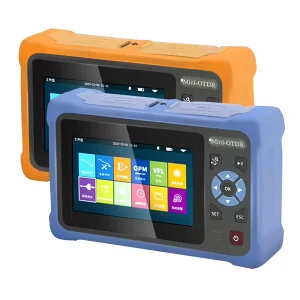
Mini OTDR testers — pocket-sized reflectometers that map events, loss and reflectance on access and short links. Request a quote.
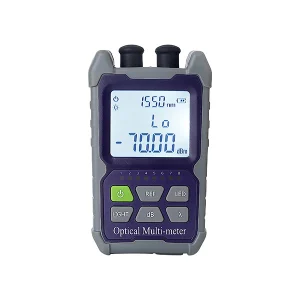
Multimode OTDR testers that characterize LAN and data-center multimode links — event mapping, loss and reflectance. Request a quote.
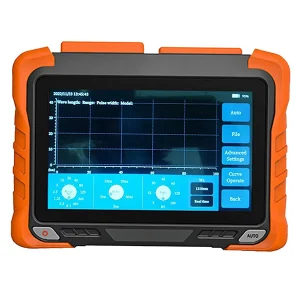
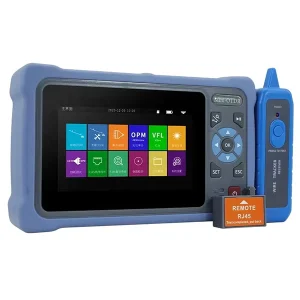
OTDR test equipment for tier-2 certification — event mapping, distance-to-fault, loss and reflectance on single-mode and multimode. Request a quote.
Explore related categories across industry, application, and performance attributes.
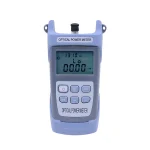 Optical Power Meter Calibrated optical power meters that measure link loss for fiber acceptance testing. Traceable accuracy across 850 to 1625nm, with PON-wavelength options for live networks. Available standalone or paired with a light source as a complete optical loss test set for two-ended certification.
 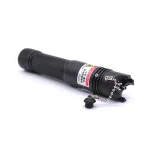 Visual Fault Locator Visual fault locator that flood a fiber with bright red laser light so breaks, tight bends and bad connectors glow visibly. The fastest way to locate a gross fault or verify continuity, working inside the OTDR dead zone, with 2.5mm, LC and MPO options and steady or pulsed output.
 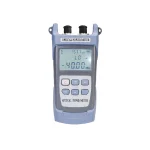 PON Tester Pass-through PON testers that read a live FTTH network without dropping subscribers. Measure downstream, upstream and video power on separate calibrated channels for GPON, EPON and 10G-PON, with pass/fail thresholds for fast turn-up and troubleshooting on working networks.
 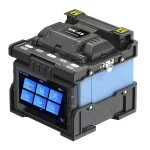 Fiber Fusion Splicer Fusion splicers that permanently join two fibers with a low-loss fused joint. Core-alignment models for backbone and long-haul (around 0.02 dB) and cladding-alignment models for cost-effective FTTH (around 0.05 dB), with fast cycle times and rugged, field-ready build.
 Field & Network Applications
An OTDR works by firing calibrated light pulses down the fiber and timing what comes back. Two things return — Rayleigh backscatter from the glass itself, and sharp Fresnel reflections from connectors, mechanical splices, and the far end. Plot that against distance and you get a trace: a map of every event, its loss in dB, and exactly how many metres away it sits. Read it well and you stop guessing where a fault is; you know.
That is why the right OTDR tester depends less on a spec sheet and more on the network in front of you. A single mode OTDR at 1550 nm reaches across metro and long-haul spans where dynamic range and a clean event map decide whether you certify or re-terminate. A multimode OTDR at 850/1300 nm suits enterprise risers and data center trunks, where a short dead zone matters far more than reach. And a PON OTDR has to see through a 1:N splitter to find the drop that failed — a very different measurement from a point-to-point link. Pick the wrong tool and the trace lies to you.
OEM / ODM Programs
Most suppliers hand you a fixed model and call it a day. We start from your requirement instead. Send us the target dynamic range, the pulse-width table, the wavelengths, and the connector — SC/APC, LC, or an MPO-ready front end — and our engineers assemble a handheld OTDR or smart OTDR platform to match, then put your name on it.
Customisation runs deeper than a sticker. We recolour and re-tool the housing, load your boot logo and UI theme, localise the firmware and the on-screen menus, and format the .sor report and PDF template to your documentation standard. Packaging follows the same logic: your carton, your quick-start guide, your accessory kit — down to the OTDR launch cables and adapters that ship in the case. The result is a complete, private-label OTDR line your distributors can sell as their own, at an MOQ that makes a first order realistic.

Need a Custom OTDR Configuration?
Tell us the dynamic range, wavelengths, dead-zone target, and connector type you need. Our engineers will match it to an OTDR platform that fits both your network and your budget — ready for private-label supply.
NDA available · ISO-aligned production · English & technical support
Six dimensions define how an OTDR performs on your network. Use them as a configuration checklist when you brief us — each one is adjustable on an OEM build.
Whether the crew needs a glove-friendly handheld OTDR for tower work or a bench unit for a repair depot changes weight, battery life, and screen size. Rugged, IP-rated bodies are available for outside-plant use.
Single mode, multimode, or both in one chassis. Wavelength sets are configurable — 1310/1550 for access and metro, 1625/1650 nm filtered for testing over live PON traffic without disturbing subscribers.
The decisive spec for reach. Higher dynamic range sees further and resolves faint events at the end of long spans; we specify it to the longest link you actually test, not a number that inflates the datasheet.
Event and attenuation dead zones govern how close together two features can sit and still be told apart — critical in patch-panel-dense data centers and short drop cables. Short dead zones are a configurable priority.
From raw-trace instruments for experts to one-touch smart OTDR analysis that auto-labels events with pass/fail icons. The level of automation is matched to who will hold the unit.
Every measurement saves as a standard .sor file that opens in any OTDR trace viewer or SOR file viewer. Batch reporting, bidirectional averaging, and branded PDF exports are configurable for acceptance workflows.
You share network type, dynamic range, wavelengths, and connector interface; we confirm the right OTDR platform.
We set firmware, wavelengths, and reporting, then align OEM housing, boot logo, and documentation to your brand.
A sample unit lets you verify trace quality, dead zone, and .sor output on your own fiber before volume.
Stable manufacturing with consistent QC, flexible MOQs, and global logistics for ongoing supply.
30 years building fiber test gear means our OTDRs are shaped by field feedback, not lab assumptions — cleaner event detection, fewer ghost reflections, calibration that holds.
Housing, firmware, boot logo, wavelength sets, and report templates are all yours to define. This is a private-label line, not a re-badged box.
Each unit is calibrated and checked against a reference fiber before it ships, so the dynamic range and dead-zone figures on the label are the ones you get.
Distributors and installers in 40+ countries reach a real engineer, usually within a business day, in English and with the trace in hand.
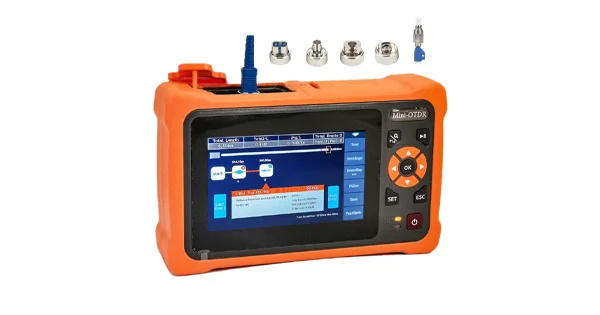
How an OTDR works: it sends a laser pulse and measures returning light. Rayleigh scattering reveals attenuation; Fresnel reflection locates events. Learn the working principle.
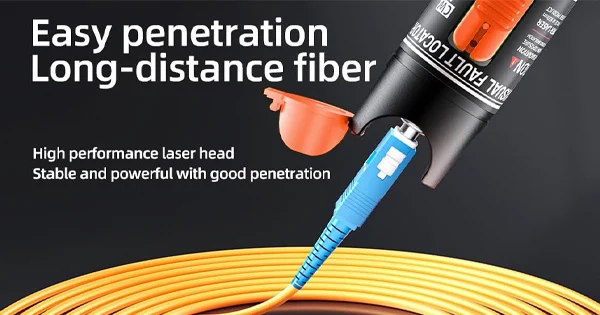
How to use a visual fault locator: connect the fiber, turn on the red laser, and find breaks, bends, and bad connectors by the light escaping. Plus VFL safety and range.
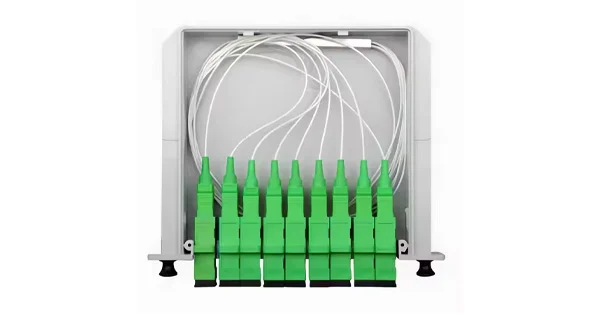
PON means Passive Optical Network. Learn how PON works, what PON on a router means, GPON vs XGS-PON, and where the technology is heading.
It measures backscatter and reflection versus distance. From that single trace you read total link loss, the loss of each splice and connector, reflectance, and the precise location of any break — which is why it is the backbone instrument for fiber certification (under standards such as IEC 61280-4) and fault-finding.
Match the instrument to the glass. Single mode OTDR units (1310/1550/1625 nm) belong on access, metro, and long-haul links; multimode OTDR units (850/1300 nm) suit enterprise and data center fiber. Buyers running mixed plant usually standardise on a dual- or quad-wavelength unit so one tool covers everything.
Yes. PON OTDR configurations are optimised to pass through 1:N splitters and to measure on live fiber, so you can verify FTTH drops and locate faults without taking active subscribers offline.
They do. Every measurement is saved as an industry-standard .sor file that opens in any OTDR trace viewer or SOR file viewer, so your team keeps its existing archiving and reporting flow.
A shorter dead zone lets the OTDR distinguish two closely spaced events — back-to-back connectors in a patch panel, or a fault near the launch point. If you test short jumpers or dense racks, prioritise it; we can configure the trade-off between dead zone and range.
That is our core business. Custom housing, boot logo, firmware, wavelengths, reporting templates, and packaging all ship under your name, with low MOQs and staged rollouts for new distributors.
Typically the OTDR, OTDR launch cables, connector adapters, and a carry case; many buyers add an optical power meter, a visual fault locator, and a fiber inspection probe so field teams carry one complete fiber test set.
Tell us about your application and we will respond with material recommendations, sample options, and pricing as soon as possible.