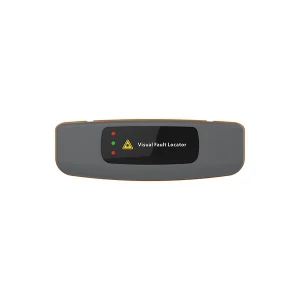
Fiber Optic Equipment
Fiber Optic Fault Detector
Fiber optic fault detectors that quickly locate breaks, bends and connection faults by making them visible. Request a quote.

Sometimes the fastest fiber test is the one you can see. A visual fault locator sends bright red laser light down the fiber, and wherever the light escapes — a break, a sharp bend, a cracked connector — it glows visibly through the jacket. No trace to interpret, no reference to set: just point, inject, and look. For finding gross faults and confirming continuity, nothing beats it for speed, and As a fiber optic visual fault locator manufacturer, Aevumix has built VFLs for field crews across three decades.
The line covers handheld visual fault locators, pen-style units, and MPO-capable models, with output powers and connector options configured to your market — all open to OEM and ODM supply.
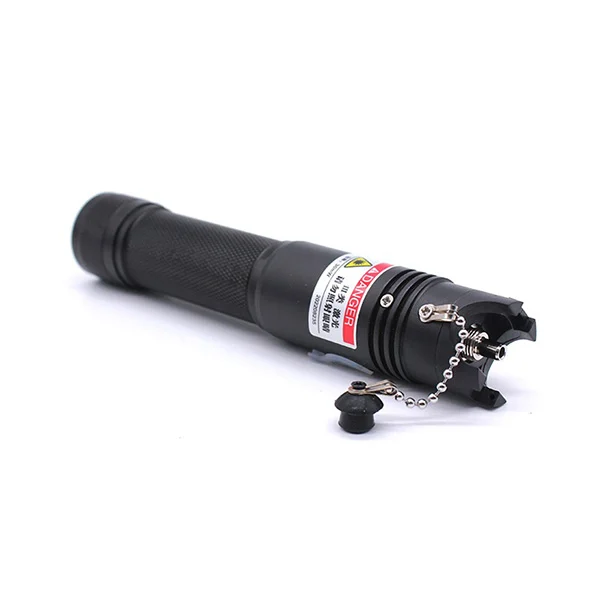
Fiber optic fault detectors that quickly locate breaks, bends and connection faults by making them visible. Request a quote.
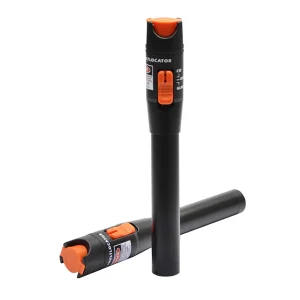
Cable fault locators that pinpoint breaks and faults in fiber cable — visible-light and reflectometer options for every distance. Request a quote.
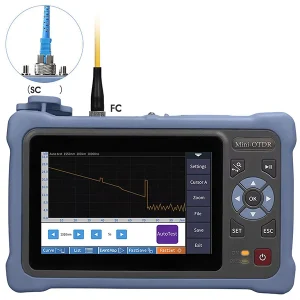
Time domain reflectometer (OTDR) cable fault locators that return distance-to-fault and event detail along the whole span. Request a quote.
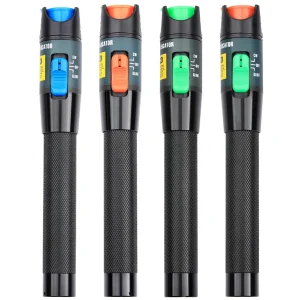
High-power visual fault locators that push visible red light farther — longer-range fault location and continuity on longer spans. Request a quote.
Explore related categories across industry, application, and performance attributes.
 OTDR Tester Handheld, mini and smart OTDR testers that map every splice, connector, bend and break along a fiber by location and loss. Available for single mode, multimode and PON networks, with clear trace analysis and standard .sor reporting for fault location and link certification.
  Optical Power Meter Calibrated optical power meters that measure link loss for fiber acceptance testing. Traceable accuracy across 850 to 1625nm, with PON-wavelength options for live networks. Available standalone or paired with a light source as a complete optical loss test set for two-ended certification.
  PON Tester Pass-through PON testers that read a live FTTH network without dropping subscribers. Measure downstream, upstream and video power on separate calibrated channels for GPON, EPON and 10G-PON, with pass/fail thresholds for fast turn-up and troubleshooting on working networks.
 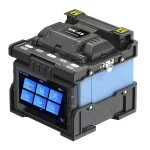 Fiber Fusion Splicer Fusion splicers that permanently join two fibers with a low-loss fused joint. Core-alignment models for backbone and long-haul (around 0.02 dB) and cladding-alignment models for cost-effective FTTH (around 0.05 dB), with fast cycle times and rugged, field-ready build.
 How a VFL Works
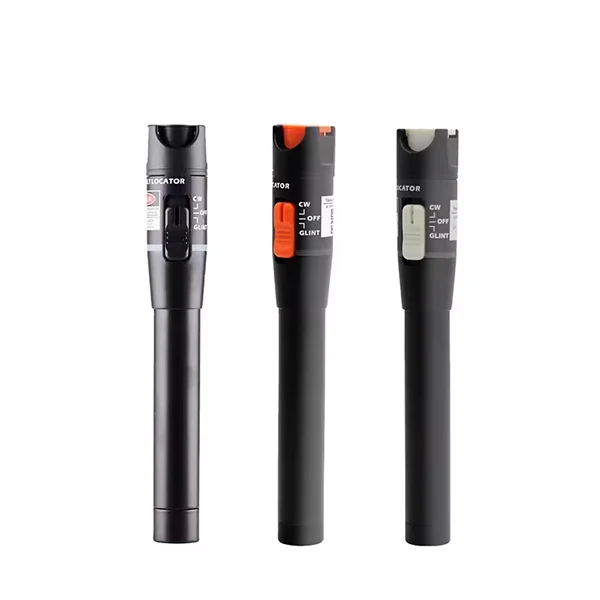
A visual fault locator trades measurement for immediacy. It couples a red laser diode — most often around 650 nm, a wavelength the eye sees easily — into the optical fiber, and relies on a simple truth: light escapes wherever the fiber is compromised. A clean fiber carries the light to the far end; a break, a macrobend tighter than the fiber tolerates, or a fractured connector lets it leak out as a visible red glow. The technician does not read a number, they see the fault. That immediacy is why a VFL is often the first tool out of the bag.
It also does two jobs an OTDR cannot. First, it finds faults in the OTDR's dead zone — the near-end stretch a trace cannot resolve — because the red light is visible right up to the connector in your hand. Second, it verifies continuity and polarity in patch cords and short jumpers in seconds, where setting up a full trace would be overkill. Selection is mainly about output power, which sets how far down the fiber a fault can still be seen, and connector compatibility — a universal 2.5 mm interface for most connectors, with adapters or dedicated models for LC and MPO. Match power to your span lengths and the VFL becomes the quickest fault-finder in the kit.
OEM / ODM Programs
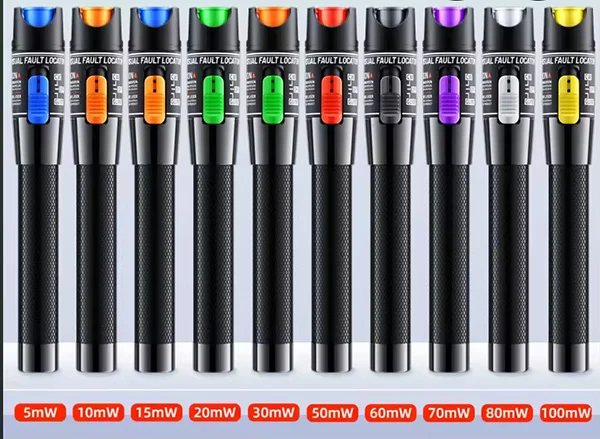
A VFL is defined by its output and its interface, so we configure the laser output power to the span lengths your customers work — from short patch-cord verification to locating faults kilometres out — and set the connector interface to their plant, whether a universal 2.5 mm coupling, an LC adapter, or a dedicated MPO version for multi-fiber trunks.
Branding runs through the tool. Body colour and finish, the printed logo, the switch and mode layout (steady and pulsed output), and the packaging all ship as your product, and the VFL slots into a private-label test kit beside the power meter and OTDR. It is a locator line built to your span lengths and connector mix, delivered at a workable MOQ, with samples so you can confirm the visibility on your own fiber before committing.
Need a Custom VFL?
Tell us the span lengths, connector types, and output your customers need. We will match them to a visual fault locator built for your workflow and your brand.
NDA available · ISO-aligned production · English & technical support
Six dimensions define a VFL build. Use them as your OEM brief.
Sets how far down the fiber a fault stays visible — matched to whether your customers verify patch cords or locate faults kilometres out.
A red laser around 650 nm, chosen for eye sensitivity, bright enough to show through standard jackets.
Universal 2.5 mm for most connectors, with LC adapters and dedicated MPO versions for multi-fiber work.
Steady (CW) for continuity and pulsed (typically 1–2 Hz) for easier fault spotting in bright conditions.
Pen-style for the pocket or handheld for higher power and battery life — matched to the crew's work.
Battery life, sealing, and build quality decide whether the VFL survives daily field and outside-plant use.
Share your span lengths, connectors, and output needs; we confirm the VFL configuration.
We set laser output, interface, and modes, then align OEM body and packaging to your brand.
Samples let you confirm fault visibility on your own fiber before volume.
Stable manufacturing with consistent QC, flexible MOQs, and global logistics for ongoing supply.
A bright, well-coupled red laser makes breaks and bends glow through the jacket — the fastest fault-finding there is.
Output power, connectors, bodies, and packaging all ship under your brand — a private-label VFL line, not a re-badged unit.
A VFL finds near-end faults inside the OTDR dead zone and verifies short jumpers an OTDR would over-serve.
A real engineer, usually within a business day, for distributors in 40+ countries.
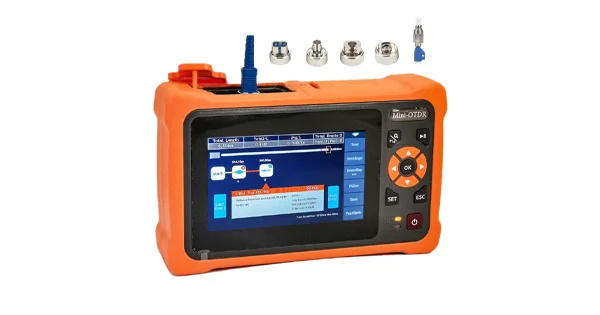
How an OTDR works: it sends a laser pulse and measures returning light. Rayleigh scattering reveals attenuation; Fresnel reflection locates events. Learn the working principle.
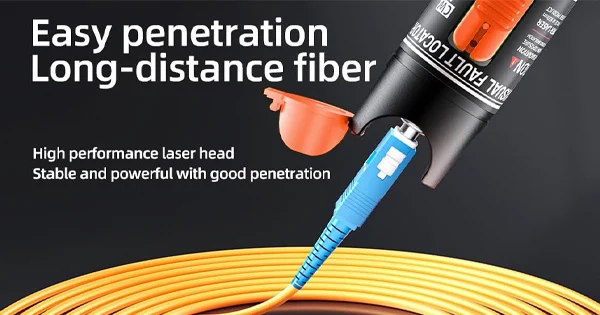
How to use a visual fault locator: connect the fiber, turn on the red laser, and find breaks, bends, and bad connectors by the light escaping. Plus VFL safety and range.
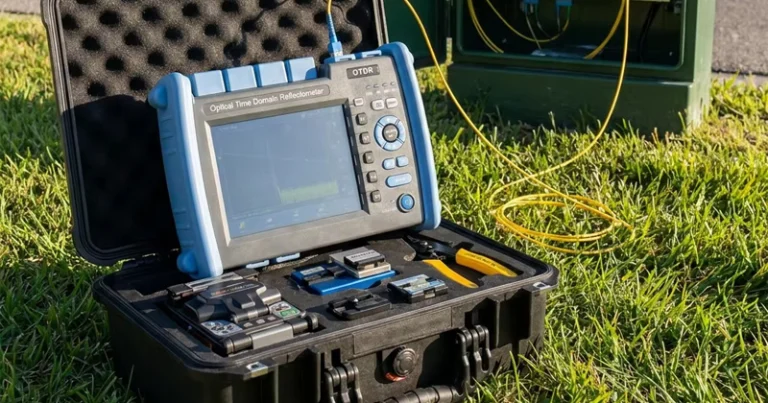
How to use an OTDR tester: cleaning, launch cables, setting pulse width and parameters, running the acquisition, and reading the trace.
To find faults you can see. It injects bright red laser light into the fiber; wherever the fiber is broken, sharply bent, or has a bad connector, the light escapes and glows visibly — the fastest way to locate a gross fault or confirm continuity.
An OTDR measures and maps events along the fiber; a VFL simply makes faults visible by eye. The VFL is faster for gross faults and short jumpers and, crucially, works inside the OTDR's near-end dead zone.
It depends on your spans. Higher output keeps a fault visible farther down the fiber. We configure output power to whether your customers verify patch cords or locate faults kilometres out.
Yes — that is one of its key uses. Because the red light is visible right up to the connector in hand, a VFL locates near-end faults an OTDR trace cannot resolve.
With the right version, yes. A dedicated MPO VFL injects light across the multi-fiber connector, and 2.5 mm and LC interfaces cover single-fiber connectors.
Steady (CW) light is best for continuity checks; pulsed light (a slow blink) is easier to spot in bright ambient conditions. Many units offer both modes.
Fully. Output power, connector interface, body finish, and packaging all carry your brand, at low MOQs — and slot into a private-label test kit.
Tell us about your application and we will respond with material recommendations, sample options, and pricing as soon as possible.