Fiber optics uses a specific, small family of light sources — and deliberately excludes many others. If you have seen the question “which of the following light sources cannot be used in fiber optic systems?” on an exam or in a course, this guide explains the answer and, more importantly, the reasoning: what makes a light source unsuitable for fiber, and why ordinary lamps simply do not work.
The Short Answer
The light sources that cannot be used in fiber optic systems are ordinary thermal / incandescent sources — incandescent bulbs, halogen and fluorescent lamps, and similar everyday lighting. They fail because they produce incoherent, broad-spectrum, undirected light that cannot be efficiently coupled into a fiber or modulated fast enough to carry data. The sources that are used are semiconductor devices: LEDs, laser diodes, and VCSELs.
What a Fiber Source Must Do
To understand why some sources are excluded, start with the demands of the job. A usable fiber source must:
- Couple into a tiny core: launch light efficiently into a fiber core that can be just microns wide.
- Emit a narrow spectrum: a broad range of wavelengths causes chromatic dispersion, spreading the pulse and corrupting data over distance.
- Modulate extremely fast: switch on and off millions to billions of times per second to encode data.
- Produce a directional beam: so the light travels into the fiber rather than radiating away in all directions.
A light source that fails any of these cannot serve as a fiber transmitter.
Why Incandescent and Thermal Sources Fail
An incandescent bulb is the classic example of a source that cannot be used. It fails on every requirement:
- Incoherent, undirected light: it radiates in all directions, so very little can be coupled into a narrow fiber core.
- Extremely broad spectrum: thermal sources emit across a huge range of wavelengths, producing severe dispersion.
- No fast modulation: a filament cannot be switched on and off at the gigahertz rates data transmission needs.
- Heat and inefficiency: most of the energy becomes heat, not usable directional light.
The same reasoning rules out halogen, fluorescent, and other general lamps. They are designed to illuminate a room, not to inject a precisely controlled, rapidly switched beam into a hair-thin glass core.
The Special Case of the LED
The LED is an interesting boundary case. An LED is a valid fiber source — but only for certain applications. Because an LED emits incoherent, broad-spectrum light, it cannot be coupled effectively into single-mode fiber, and it cannot support high data rates. So while an LED is not excluded from fiber optics altogether, it cannot be used for single-mode or high-speed applications — those require a laser diode or VCSEL. On an exam, “LED for single-mode fiber” is often the intended wrong answer for exactly this reason.
Usable vs Unusable Sources at a Glance
| Source | Usable in Fiber? | Why |
| Incandescent / halogen bulb | No | Incoherent, broad spectrum, undirected, cannot modulate fast |
| Fluorescent lamp | No | Same limitations as other thermal/general lamps |
| LED | Yes (multimode, low speed only) | Incoherent; not for single-mode or high speed |
| Laser diode (FP / DFB) | Yes | Coherent, narrow, directional; single-mode, long-distance |
| VCSEL | Yes | Coherent, fast, low cost; high-speed multimode |
The Role of Wavelength
Beyond coherence, the wavelength a source emits matters just as much for whether it can be used. Fiber optic systems deliberately operate in the infrared, principally at 1310 nm and 1550 nm for single-mode work and 850 nm for multimode, because the glass fiber is most transparent at those wavelengths — loss is lowest and transmission distance is greatest. A source emitting outside these windows, or across a wide band that includes them, does not match the fiber’s low-loss regions and suffers high attenuation and dispersion. This is another reason ordinary lamps fail: their output is spread across the visible and infrared spectrum with no regard for the fiber’s transmission windows. The semiconductor sources used in fiber are engineered to emit precisely at these wavelengths with a narrow spectral width, which is exactly what keeps signals strong and clean over distance.
Coherence: The Deciding Property
The property that separates usable from unusable sources is coherence. Coherent sources (laser diodes, VCSELs) generate light in an optical cavity, giving a monochromatic, directional, tightly controlled beam that couples into fiber and modulates at high speed. Incoherent sources fall into two groups: LEDs, which are coherent enough and fast enough for multimode short-range use, and thermal sources like incandescent bulbs, which are so broadband and undirected that they are useless for fiber. The further a source sits from coherence, the less suitable it is — and thermal lamps sit at the far end.
A Note on Test Light Sources
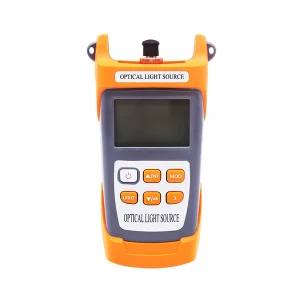
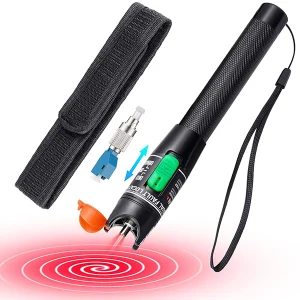
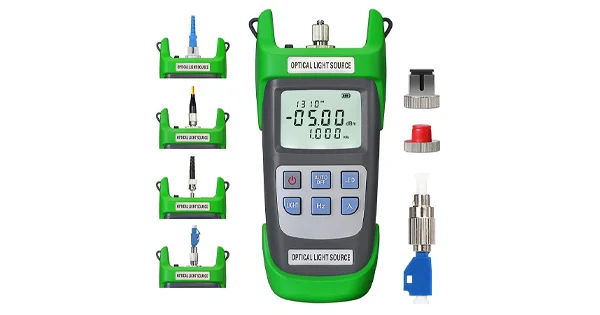
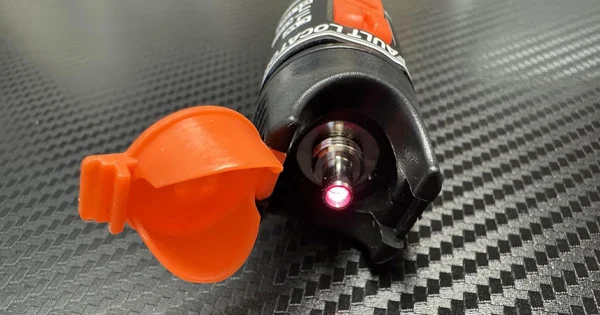
The same principles apply when you pick a source for testing rather than transmission. A fiber test light source must use a proper semiconductor emitter matched to the fiber — an LED for multimode, a laser for single-mode — because a test is only meaningful if the launch conditions resemble real network conditions. You could not, for instance, shine a flashlight or a lamp into a fiber and measure anything useful, for exactly the reasons that rule those sources out of transmission: no defined wavelength, no coherence, no stable directional coupling. This is also why standards specify the encircled-flux launch method for multimode testing, so that an LED-based test source mimics the launch of the VCSELs that live networks actually use. The lesson is consistent across both worlds: only engineered semiconductor sources belong in a fiber, whether the goal is carrying data or measuring a link.
Why This Matters in Practice
This is not just exam trivia. Choosing the right source is fundamental to a working link. Use an LED where a laser is needed and the link will be too slow or won’t reach; the reverse wastes money on short runs. And no amount of engineering can make an incandescent lamp carry fiber data. Understanding why certain sources are excluded is really understanding what makes fiber transmission work at all.
Get the Right Fiber Sources and Test Tools
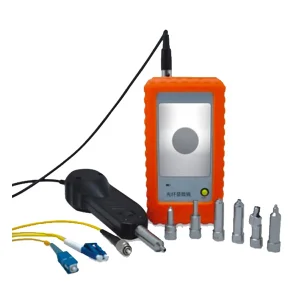
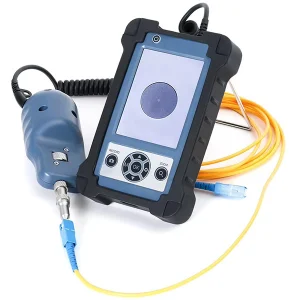
Matching the correct semiconductor source to your fiber and application is essential. Aevumix supplies stabilized LED and laser light sources, optical power meters, and complete test kits for multimode and single-mode networks. If you would like help choosing the right source for your fiber, contact our team.
FAQs
Which Light Sources Cannot Be Used in Fiber Optic Systems?
Ordinary thermal and incandescent sources — incandescent bulbs, halogen, and fluorescent lamps — cannot be used. They produce incoherent, broad-spectrum, undirected light that cannot couple into a fiber core or modulate fast enough to carry data.
Why Can’t an Incandescent Bulb Be Used in Fiber Optics?
Because it emits incoherent light in all directions across a very broad spectrum and cannot be switched on and off at high speed. Little of its light couples into the fiber, it causes severe dispersion, and it cannot modulate data.
Can an LED Be Used in Fiber Optics?
Yes, but only for multimode, lower-speed applications. An LED’s incoherent, broad-spectrum output cannot couple into single-mode fiber or support high data rates, so those require a laser diode or VCSEL.
What Light Sources Are Used in Fiber Optics?
Semiconductor sources: LEDs for multimode short-range links, laser diodes (Fabry-Perot and DFB) for single-mode long-distance links, and VCSELs for high-speed multimode applications such as data centers.
What Makes a Light Source Suitable for Fiber?
Coherence, a narrow spectrum, a directional beam that couples into a small core, and the ability to modulate at very high speed. Coherent semiconductor sources meet these; thermal lamps do not.