Every fiber optic link begins with a light source — a device that converts an electrical signal into the light that carries data down the fiber. But not just any light will do. This guide explains the light-emitting sources used in fiber optics: the main types (LED, laser diode, and VCSEL), how they differ, and which fiber and application each one suits.
Why Fiber Needs Special Light Sources
A fiber optic source has a demanding job: it must switch on and off millions to billions of times per second while launching a tiny, precisely controlled beam of light into a fiber core that can be just microns wide. That rules out ordinary lamps and leaves a small family of semiconductor devices designed specifically for the task. All of them convert electrical signals into optical signals, but they differ significantly in how they emit light, how fast they can modulate, and which fiber they couple into.
The Three Main Light Sources
Commercially deployed fiber optic technologies use one of three semiconductor light sources: the LED, the laser diode, and the VCSEL.
LED (Light-Emitting Diode)
An LED is a semiconductor that emits light through spontaneous emission when current passes through its junction. Its output is incoherent, with a broad spectral width and a wide beam, so it couples well into the larger core of multimode fiber. LEDs are inexpensive and robust, and were the original source for early 10 and 100 Mbps multimode links. Their limitation is speed: their broad spectrum causes chromatic dispersion, and their modulation rate cannot keep up with gigabit and higher transmission.
Laser Diode (FP and DFB)
A laser diode produces light by stimulated emission inside an optical cavity, giving a coherent, highly monochromatic, and very directional output. That narrow, tight beam couples efficiently into single-mode fiber, making laser diodes ideal for long-distance, high-speed links. The two common edge-emitting types are the Fabry-Perot (FP) laser and the distributed-feedback (DFB) laser, the latter offering an especially narrow spectral width for the longest, fastest spans. Lasers cost more and are harder to fabricate and calibrate, but deliver higher bandwidth, longer reach, and lower error rates.
VCSEL (Vertical-Cavity Surface-Emitting Laser)
A VCSEL is a semiconductor laser that emits its coherent beam vertically from the chip surface rather than the edge. It emerged as the answer to a specific problem: when Gigabit Ethernet arrived, LEDs could not modulate fast enough and edge-emitting lasers were too expensive for short-reach multimode links. VCSELs bridged the gap — cheap to fabricate like an LED, but fast and directional like a laser. They are typically made for 850 nm, the multimode wavelength, and their circular, low-divergence beam couples easily into fiber. Today’s high-speed multimode networks and data centers rely heavily on 850 nm VCSELs.
Comparing the Three Sources
| Source | Emission | Typical Wavelengths | Fiber / Use |
| LED | Incoherent, broad spectrum | 850 nm, 1300 nm | Multimode; legacy short-range, lower speed |
| Laser diode (FP / DFB) | Coherent, narrow spectrum | 1310 nm, 1550 nm | Single-mode; long-distance, high speed |
| VCSEL | Coherent, narrow, surface-emitting | 850 nm | Multimode; high-speed data centers, Ethernet |
How the Sources Actually Emit Light
The differences between these sources come down to how they generate light at the semiconductor level. An LED works by spontaneous emission: as current crosses the junction, electrons and holes recombine and release photons in random directions and across a range of energies, which is why the output is broad-spectrum and spreads widely. A laser diode adds an optical cavity — formed by reflective facets — that forces stimulated emission, where one photon triggers the release of identical photons, building a coherent, monochromatic, tightly directed beam. A VCSEL achieves the same stimulated emission but uses distributed Bragg reflectors above and below the active region to create a vertical cavity, so the coherent beam exits the top surface of the chip in a circular, low-divergence pattern that couples neatly into fiber. Understanding these mechanisms explains every practical difference that follows: spectral width, beam shape, modulation speed, and which fiber each source suits.
Coherent vs Incoherent: The Key Distinction
The single most important difference among sources is coherence. A coherent source (laser diode, VCSEL) produces light in an optical resonant cavity, giving a highly monochromatic, directional beam that couples efficiently into fiber — especially single-mode fiber. An incoherent source (LED) has no such cavity, so its output has a broad spectral width and a wide, diverging beam. That is why LEDs are generally limited to multimode fiber, where their spread-out light can still be coupled in useful quantities, while lasers and VCSELs suit the precise coupling that high-speed and single-mode links require.
Choosing the Right Source
Selecting a source comes down to matching it to the fiber and the application. For short-range, lower-speed multimode links, an LED may suffice. For high-speed multimode in data centers and Ethernet, an 850 nm VCSEL is the standard choice. For long-distance, high-speed single-mode transmission — telecom backbones, FTTx, and metro networks — a laser diode (FP or DFB) at 1310 or 1550 nm is required. The interplay of fiber geometry, attenuation versus wavelength, dispersion, source power, spectral width, and modulation speed all guide the choice.
Modulation: Turning Light Into Data
A light source does more than emit light — it must encode data by switching that light on and off, or varying its intensity, at very high speed. This is where the differences between sources become decisive. An LED can be directly modulated but only up to a few hundred megabits per second before its broad spectrum and slower response become limiting, which is why it served early low-speed links but could not scale. Laser diodes and VCSELs modulate far faster — well into the gigabit and multi-gigabit range — because stimulated emission responds quickly and their narrow spectra avoid the dispersion penalties that would otherwise smear fast pulses. This modulation capability, alongside coupling efficiency and spectral width, is one of the main reasons a network designer chooses a laser or VCSEL over an LED as data rates climb.
Sources in Testing vs Transmission
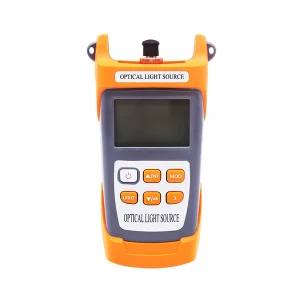
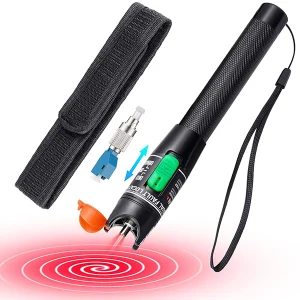
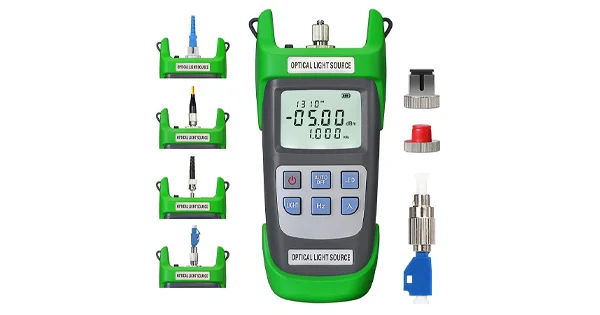
The same source families appear in test equipment. A fiber test light source uses an LED or laser matched to the fiber under test, launching a stable, known output so an optical power meter can measure loss. Notably, LED sources are still used for testing multimode fiber even though live networks now use VCSELs, which is why standards define the encircled-flux launch method to make LED test results match real VCSEL launch conditions.
Get the Right Light Sources
Whether for transmission or testing, matching the source to your fiber and wavelengths is essential. Aevumix supplies stabilized LED and laser light sources, optical power meters, and complete test kits for multimode and single-mode networks. If you would like help choosing a light source for your fiber and application, contact our team.
FAQs
What Light Sources Are Used in Fiber Optics?
Three semiconductor sources dominate: LEDs (incoherent, for multimode short-range), laser diodes such as Fabry-Perot and DFB types (coherent, for single-mode long-distance), and VCSELs (coherent, surface-emitting, for high-speed multimode).
What Is the Difference Between an LED and a Laser Source?
An LED emits incoherent, broad-spectrum light through spontaneous emission and suits multimode fiber. A laser diode emits coherent, narrow, directional light through stimulated emission in an optical cavity, coupling efficiently into single-mode fiber for high-speed, long-distance links.
What Is a VCSEL and Why Is It Used?
A VCSEL is a laser that emits vertically from the chip surface. It combines low cost with high modulation speed, which is why 850 nm VCSELs became the standard source for high-speed multimode links and data centers when LEDs proved too slow and edge-emitting lasers too costly.
Why Are Lasers Used for Single-Mode Fiber?
Single-mode fiber has a tiny core, so it needs the narrow, coherent, directional beam a laser produces to couple light in efficiently. An LED’s broad, diverging output cannot be coupled into single-mode fiber in useful quantities.
Which Source Is Best for Long Distances?
Laser diodes — particularly DFB lasers at 1310 or 1550 nm on single-mode fiber — are best for long distances because their narrow spectral width minimizes dispersion and their coherent beam enables low-loss, high-speed transmission over long spans.