The “ends” of a fiber optic cable are where all the action happens — the polished connector end faces that mate to equipment, and the bare glass strand prepared for splicing. Both are extremely sensitive to contamination. Learning how to clean fiber optic cable ends correctly is one of the most important skills for anyone installing or maintaining an optical network.
This guide explains how to clean both types of cable ends, the tools you need, and the mistakes that quietly cause signal loss.
Why Cable Ends Are So Sensitive
A single-mode fiber core is only about 9 microns across. Any dust speck, oil smear, or fingerprint sitting on that core blocks the light path, causes insertion loss, and produces back reflection. When a contaminated end is mated to a clean one, both surfaces become dirty and trapped particles can leave permanent scratches and pits on the glass.
That is why the industry treats cable ends with such care: contamination on the end face is the single most common source of optical network faults, and it is almost entirely preventable.
Two Types of Cable Ends
- Connector end faces: the polished ferrule tips at the ends of patch cords and pigtails that plug into adapters and equipment.
- Bare fiber ends: the stripped glass strand prepared for a fusion or mechanical splice.
Each is cleaned differently, so we will cover both.
How to Clean Connector End Faces
Always follow the inspect–clean–inspect method.
Step 1: Inspect the End Face
Remove the dust cap and inspect the ferrule with a fiber scope or digital probe. Check the core and cladding zones for particles, streaks, or films. If it is clean, mate it — no cleaning required.
Step 2: Dry Clean Light Contamination
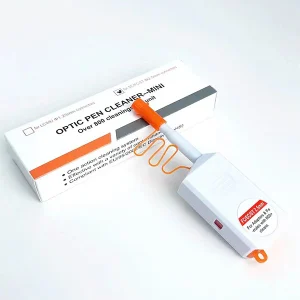
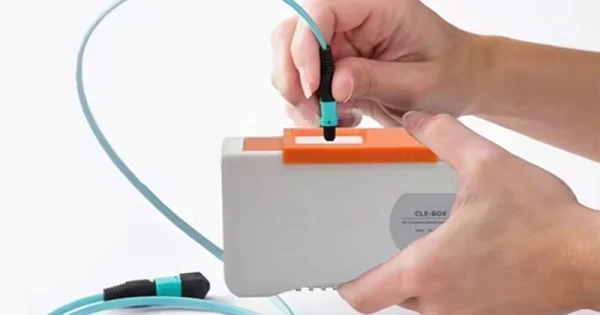
For dust and lint, use a one-click cleaner for connectors in adapters and ports, or a cassette cleaner or lint-free wipe for exposed ferrules. Move the ferrule across the cleaning surface in one straight motion and always advance to a fresh section.
Step 3: Wet-to-Dry for Oils and Residue
For fingerprints, oils, or dried residue, place a small drop of fiber-grade fluid or ≥99% isopropyl alcohol on a lint-free wipe, draw the ferrule from the wet area straight to the dry area, and finish dry. This clears the static charge a dry-only wipe leaves behind.
Step 4: Re-Inspect Before Mating
Inspect again to confirm a clear, defect-free end face. Repeat if contamination remains, then mate or recap immediately.
How to Clean Bare Fiber Ends for Splicing
Bare fiber ends are cleaned at one precise moment: after stripping, before cleaving.
Once the jacket, buffer, and acrylate coating are stripped, the exposed glass carries coating residue and debris. Wipe it once with a lint-free wipe lightly dampened with a fast-drying, fiber-grade fluid, then wipe dry so no liquid remains. Do not touch the glass afterward — go straight to cleaving.
Critical rule: clean before cleaving, never after. A freshly cleaved end face is the cleanest surface you will ever have; wiping it only contaminates it. Leaving residue on the fiber causes poor cleaves, weak splices with bubbles, and higher loss.
Types of Contamination on Cable Ends
Different contaminants call for different cleaning. Recognizing them speeds up the job:
- Dust and lint: the most common contamination, easily attracted by static. It may sit outside the core but migrates into the critical zone when mated. Dry cleaning usually removes it.
- Oils and fingerprints: transparent films that change the refractive index at the interface and raise reflectance, sometimes visible as a rainbow sheen under a scope. These require wet-to-dry cleaning.
- Coating residue: acrylate and buffer debris left on bare fiber after stripping. It causes poor cleaves and weak splices, so it must be wiped away before cleaving.
- Solvent residue: left behind by low-purity or slow-drying alcohol. Using fiber-grade, fast-drying fluid and finishing dry prevents it.
Why Inspection Is Non-Negotiable
You cannot reliably judge a fiber end face with the naked eye — the core is only about 9 microns across. A fiber inspection scope or digital probe shows the core, cladding, and surrounding zones so you can see whether contamination sits in the critical light-carrying area. Digital probes with automated pass/fail analysis remove the guesswork entirely, and inspecting after cleaning is the only way to confirm the end is truly ready to mate. Inspection is what turns cleaning from a hopeful wipe into a verifiable result.
Cleaning Cable Ends: Quick Reference
| Cable End | When to Clean | Method & Tools |
| Connector end face | Before every mating | Inspect–clean–inspect; one-click, cassette, or wipe |
| Bare fiber end | After stripping, before cleaving | Wet method; fast-drying fluid + lint-free wipe |
| Recessed port end | Before connecting equipment | Connector-specific swab, lightly dampened |
What Dirty Cable Ends Cost You
The stakes justify the few seconds cleaning takes. Contamination on a cable end raises insertion loss and back reflection, producing slow or intermittent links that are difficult to diagnose. On modern high-speed networks, poor connector reflectance is a primary enemy of reliable performance. Worse, mating a contaminated end to a clean one spreads the problem to both surfaces, and hard particles caught in the contact zone can leave permanent scratches and pits in the glass. That kind of physical damage cannot be cleaned away — it means re-terminating or replacing the cable. Clean ends are simply cheaper than dirty ones.
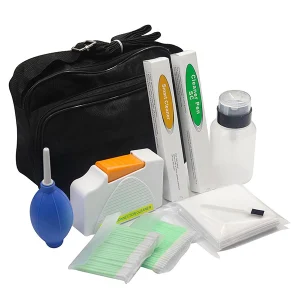
Tools You Need for Clean Cable Ends
- Fiber inspection scope or digital probe — the basis of inspect–clean–inspect.
- One-click / push-type cleaners — for connectors in adapters and ports (2.5 mm and 1.25 mm).
- Cassette / reel cleaners — for exposed ferrules and stubborn debris.
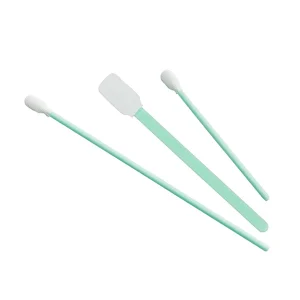
- Lint-free wipes and swabs — for wet-to-dry cleaning and recessed interfaces.
- Fiber-grade cleaning fluid or ≥99% IPA — fast-drying and low-residue.
Common Mistakes to Avoid
- Cleaning bare fiber after cleaving — always clean before.
- Reusing wipes or swabs — a used surface redeposits particles.
- Touching the end face or glass — skin oil is hard to remove.
- Flooding with fluid — excess liquid wicks contamination inside the connector.
- Trusting dust caps to be clean — caps protect, they do not clean.
Best Practices for Clean Cable Ends
A handful of habits keep cable ends reliably clean. Prepare in a tidy work area, because airborne dust settles onto exposed ends the moment a cap comes off. Follow a “clean before connect” rule so every mating begins from a verified-clean state, new components included. Open sealed consumables only as you need them and reseal or discard them promptly so they never gather contamination. Cap cleaned connectors right away to protect them until they are mated. For splice work, remember the sequence — strip, clean, cleave — and keep your stripping tools, cleaver, and V-grooves clean too, since residue in fixtures reappears on the next fiber. Above all, inspect before and after; verification is what makes the cleaning trustworthy.
Get Purpose-Built Cleaning Products
Reliable cable ends depend on optical-grade consumables. Aevumix manufactures a complete range of fiber optic cleaning products — one-click cleaners, cassette cleaners, cleaning pens, swabs, lint-free wipes, and fiber-grade solvents — for both connector and splice work. If you would like help choosing the right products for your cable ends and workflow, contact our team.
FAQs
What Is the Best Way to Clean Fiber Optic Cable Ends?
For connector ends, use the inspect–clean–inspect method with a one-click cleaner or wet-to-dry wipe. For bare fiber ends, clean with a fast-drying fiber-grade fluid on a lint-free wipe after stripping and before cleaving.
Should I Clean the Fiber End Face After Cleaving?
No. Clean the bare fiber before cleaving. The freshly cleaved end face is already pristine, and cleaning it afterward only introduces contamination that weakens the splice.
Can I Use Rubbing Alcohol on Fiber Cable Ends?
Only high-purity (≥99%) isopropyl alcohol or a fiber-grade fluid, always followed by a dry pass. Standard rubbing alcohol is often 70% and denatured, which leaves a film and can be corrosive to connectors.
Why Do I Still Get Loss After Cleaning the Ends?
Persistent loss may mean a permanent defect such as a scratch or pit in the core zone rather than removable debris, or re-contamination from a dirty cap or reused wipe. Inspect the core under a scope; a physical defect in the critical zone may require replacing the connector.
Do I Need to Clean Brand-New Cable Ends?
Yes. Even new, capped connectors should be inspected and cleaned before the first mating, because dust caps and handling can leave contamination on the end face.