When a fiber installation is handed over to a client, it usually has to be certified — proven to meet industry standards. That requires specific instruments. If you are wondering what fiber optic certification tools are, this guide explains the tools involved, the difference between Tier 1 and Tier 2 testing, and what each instrument does.
What Is Fiber Optic Certification?
Fiber optic certification is the process of verifying that installed cabling meets industry standards for loss, length, and performance. It produces documented pass/fail results proving the link is ready to support the intended application. Certification is governed by standards from bodies such as TIA, ISO/IEC, and IEEE, and it is what contractors use to demonstrate compliance and support warranty claims.
Certification is defined in two tiers, and the tools you need depend on which tier is required.
What Certification Actually Measures
It helps to know the specific parameters certification checks. Tier 1 focuses on three: insertion loss (the total signal loss end to end, in dB, compared against the link’s loss budget), length (confirming the run is within the distance limit for the application), and polarity (verifying the fibers connect transmit-to-receive correctly, which matters especially for duplex and multifiber links). Tier 2, using an OTDR, adds per-event detail: the loss and reflectance of each connector and splice, optical return loss, and the exact distance to every event. Together these paint a complete picture — Tier 1 proves the link as a whole meets the budget, while Tier 2 shows how each component contributes. Understanding which parameter each tier measures is what lets you choose the right tool and read the results correctly.
Tier 1 Certification Tools: OLTS
The core Tier 1 certification tool is the Optical Loss Test Set (OLTS), also called a fiber certifier. Under ANSI/TIA-568.3-D, Tier 1 (basic) testing checks link attenuation (insertion loss), continuity/length, and polarity — and it is the required level for certification.
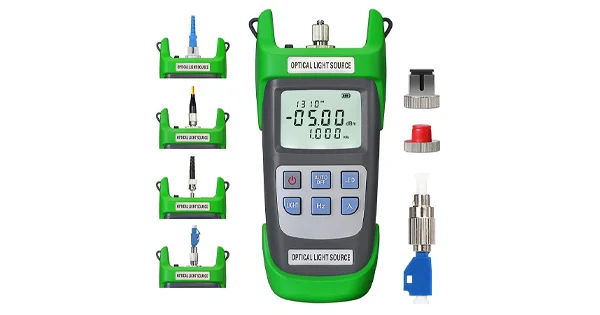
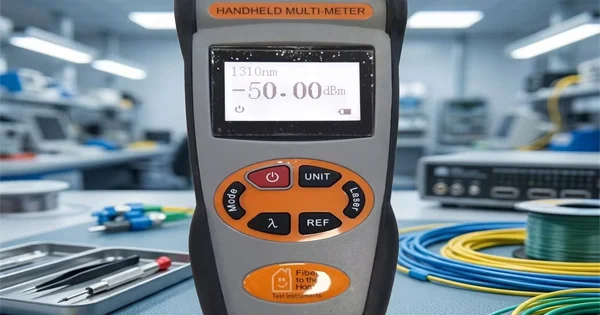
An OLTS pairs a stabilized light source at one end with an optical power meter at the other to measure precisely how much light reaches the far end, giving the total end-to-end insertion loss. It comes either as a light source plus a separate power meter, or as a single integrated unit with certification software that generates standardized reports. Because Tier 1 results are what standards bodies accept for certification, the OLTS is the essential certification tool.
Tier 2 Certification Tools: OTDR
The Tier 2 (extended) tool is the Optical Time-Domain Reflectometer (OTDR). It sends laser pulses into the fiber and measures the reflected and backscattered light to build a trace — a graphical picture of the link showing the loss of each individual connector, splice, and cable segment, plus the distance to each.
Tier 2 testing is listed as optional in TIA-568.3-D, and importantly, an OTDR result alone is not accepted by TIA to certify performance — Tier 1 OLTS testing must still be completed. The OTDR’s value is in documentation, fault location, splice and connector characterization, and troubleshooting. In practice, Tier 1 must be done for certification, and Tier 2 complements it for deeper analysis.
Supporting Tools You Also Need
Certification does not happen with an OLTS alone. Several supporting tools are essential to get valid results:
- Fiber inspection scope or probe: to inspect and verify connector end faces are clean before testing — dirty connectors cause most test failures.
- Cleaning tools: one-click cleaners, wipes, and fluid to clean end faces as part of inspect–clean–inspect.
- Test reference cords (TRCs): known-good launch cords that meet standard requirements, used to set the reference.
- Visual fault locator (VFL): to confirm continuity and polarity and to find breaks or sharp bends visually.
Certification Tools at a Glance
| Tool | Tier | What It Certifies / Does |
| OLTS (fiber certifier) | Tier 1 (required) | Insertion loss, length, polarity — pass/fail |
| OTDR | Tier 2 (optional) | Per-event loss, reflectance, fault location, trace |
| Inspection scope / probe | Prerequisite | Verifies clean connector end faces |
| Cleaning tools | Prerequisite | Clean end faces before testing |
| Visual fault locator | Support | Continuity, polarity, visible fault location |
Why Certification Matters
Certification is more than a formality — it protects everyone involved in a fiber project. For the installer, documented pass/fail results prove the work was done to standard and support warranty claims if a component later fails. For the client, certification is assurance that the cabling will reliably carry current and future applications rather than becoming a hidden bottleneck. For troubleshooting down the line, a certification report captured at install time is a baseline snapshot of the system; comparing a later test against it quickly reveals what has changed. As networks push to higher speeds, the margin for error shrinks, which is exactly why formal certification with proper tools has become standard practice on professional installations rather than an optional extra.
The Certification Workflow
A typical certification sequence runs in a set order. First, inspect and clean every connector end face with a scope and cleaning tools, since contamination is the leading cause of failures. Next, perform Tier 1 certification with the OLTS, measuring insertion loss, length, and polarity against the loss budget and recording pass/fail results. Then, if required or for deeper analysis, perform Tier 2 testing with an OTDR to characterize individual events and locate any faults — remembering that Tier 1 must be completed for the certification to be valid. Finally, generate and archive the reports as the documented proof of compliance.
Choosing Certification Tools for Your Projects
Selecting the right certification kit depends on the work you take on. If you certify enterprise LANs and data-center links, an integrated OLTS certifier that tests both single-mode and multimode fiber and generates standardized reports will cover most jobs quickly. If you install access networks or long single-mode spans, add an OTDR with the wavelengths and dynamic range those distances require, plus launch and receive cables. For multimode certification, make sure your source meets encircled-flux launch requirements so results are consistent and standards-compliant. Across all of these, a fiber inspection scope and cleaning tools are non-negotiable because contamination causes most failures, and a set of standard-compliant test reference cords is essential for a correct reference. Matching the kit to your typical projects avoids both under-equipping and paying for capability you will rarely use.
Why Reference Method and Cleanliness Matter
Two details make or break certification results. The reference method — how the OLTS is zeroed with test reference cords — must match what the standard specifies (the one-jumper method is the common industry approach), because the wrong method counts the wrong connectors and skews the loss figure. And inspection and cleaning cannot be skipped: dirty connectors cause most test failures, so verifying clean end faces before every measurement is part of doing certification correctly.
Get the Right Certification Tools
Certifying fiber to standard depends on quality, well-matched instruments. Aevumix supplies optical loss test sets, optical power meters, light sources, OTDRs, visual fault locators, and inspection and cleaning tools for single-mode and multimode networks. If you would like help assembling a certification kit for your projects, contact our team.
FAQs
What Are Fiber Optic Certification Tools?
They are the instruments used to prove installed fiber meets standards: an OLTS for Tier 1 loss, length, and polarity certification, an OTDR for Tier 2 event characterization and fault location, plus inspection scopes, cleaning tools, and reference cords.
What Is the Difference Between Tier 1 and Tier 2 Certification?
Tier 1 (required) uses an OLTS to certify total insertion loss, length, and polarity. Tier 2 (optional) uses an OTDR to characterize individual events and locate faults. Tier 1 must be completed for a valid certification.
Can an OTDR Certify Fiber on Its Own?
No. TIA does not accept an OTDR result alone to certify fiber performance. Tier 1 OLTS testing is required; the OTDR (Tier 2) complements it for documentation and troubleshooting.
Do I Need to Clean Connectors Before Certifying?
Yes. Dirty connectors cause most test failures. Inspecting and cleaning every end face with a scope and cleaning tools is a prerequisite step before Tier 1 or Tier 2 testing.
What Is an OLTS?
An Optical Loss Test Set pairs a stabilized light source and an optical power meter to measure a link’s end-to-end insertion loss. It is the primary Tier 1 fiber certification tool and often includes reporting software.