If you have fiber or broadband service, there is a small box where the provider’s line ends and your own network begins. That box is often a Network Termination Unit. This guide explains what a Network Termination Unit (NTU) is, what it does, how it relates to the ONT on a fiber connection, and why it matters for troubleshooting and responsibility.
What Is a Network Termination Unit?
A Network Termination Unit (NTU) is a device that serves as the demarcation point between the service provider’s network and the customer’s premises. In plain terms, it is the formal hand-off point — where the provider’s responsibility ends and your internal network begins. It terminates the incoming network connection and provides a clear separation between the external network and your internal wiring.
Because it sits exactly on that boundary, the NTU is where issues can be isolated: a problem is either on the provider’s side of the NTU or on the customer’s side, which makes troubleshooting far clearer.
Different Names for the Same Idea
You may encounter the network termination concept under several names, which can be confusing. On fiber it is usually the ONT or ONU; on some national broadband networks it is called a network termination device or NTD; on cable service the cable modem fills the role; and in older telecom it was simply the NTU. Despite the different labels, the underlying idea is consistent: a device at the customer boundary that terminates the provider’s access line and converts it into interfaces your equipment can use. The variety of names largely reflects the variety of access technologies — fiber, copper, and coax each evolved their own terminology — but the function they name is the same demarcation-and-conversion role. Recognizing that these terms point to the same boundary device makes provider documentation and support conversations much easier to follow.
What Does an NTU Do?
Beyond marking the boundary, an NTU performs several practical functions:
- Signal conversion: it converts the provider’s access signal (delivered over fiber, copper, or coax) into customer-usable interfaces such as Ethernet.
- Demarcation: it establishes a clear point of responsibility between provider and customer.
- Signal integrity: it adapts and manages signals so data, voice, and video flow without unnecessary loss or degradation.
- Diagnostics and monitoring: many NTUs include features that help isolate and troubleshoot faults, and modern units can often be monitored or managed remotely by the provider.
NTU and the Fiber ONT: What’s the Relationship?
On a fiber-to-the-home connection, the NTU function is usually performed by the ONT (Optical Network Terminal), sometimes also called an ONU. When you are provisioned with fiber, a technician installs this optical NTU/ONT, and you plug your router into its Ethernet port. In other words, on fiber the ONT is your network termination unit — it terminates the optical line and hands off Ethernet to your equipment. On cable (HFC) service, the equivalent termination function lives in the cable modem that bridges the provider’s signal to Ethernet.
Where the NTU Sits in Your Setup
| Element | Role | Whose Side |
| Provider’s access line (fiber/copper/coax) | Carries the service to your premises | Provider |
| NTU / ONT | Terminates the line; demarcation point; converts to Ethernet | Boundary |
| Your router | Creates your home/office network | Customer |
| Your devices | Use the connection | Customer |
NTU vs Router vs Modem: Clearing Up the Confusion
These terms are often mixed up, but each has a distinct role. The NTU (on fiber, the ONT) terminates the provider’s line and marks the demarcation point — it is the boundary device. A modem, in the traditional sense, converts between the provider’s signal and a form your equipment understands; on fiber the ONT performs this conversion, while on cable the cable modem does. A router then takes the single connection handed off by the NTU and creates your local network, sharing it among your devices and providing Wi-Fi. In some setups these functions are combined into one box, which is why the distinction blurs, but conceptually the NTU is the hand-off point, the modem is the translator, and the router is what builds your own network on top. Knowing which device does what makes it much easier to pinpoint where a problem lies.
Why the Demarcation Point Matters
The demarcation point is not just a technical detail — it has practical and regulatory importance. It defines who owns and maintains which cabling, and therefore who is responsible for fixing what. In many jurisdictions the boundary is explicitly defined; in the United States, for example, the regulator sets where the provider’s responsibility ends and the customer’s wiring begins. When something goes wrong, knowing that the NTU is the boundary tells you whether to call the provider (a fault on their side) or troubleshoot your own equipment (a fault on your side).
Troubleshooting Around the NTU
Because the NTU sits on the boundary, it is the natural starting point when service fails. If the NTU or ONT has no power or shows no link light, the problem is likely the unit or the provider’s line rather than anything in your home. If the NTU shows a healthy link but your devices have no internet, the fault is probably on your side — the router, its configuration, or the cable between the NTU and router. Reseating the connection between the NTU and your router, and rebooting both, resolves many issues. If the NTU itself reports a fault after that, the provider can usually test remotely up to the unit and confirm whether the trouble is theirs or yours. Using the NTU as this dividing line turns a vague “the internet is down” into a clear question of which side of the boundary to investigate.
A Brief History: NTUs and ISDN
The term NTU has been used in telecommunications for decades. In older ISDN systems, the NTU was a critical device that terminated the line at the customer end of the local loop and converted the network’s interface into a form that customer equipment — ISDN phones, routers, and similar devices — could use. While ISDN has largely given way to fiber and broadband, the core idea has carried straight through: a device at the customer boundary that terminates the provider’s line and adapts it for local use. Today’s ONT on a fiber connection is the modern expression of that same role.
NTU and Network Testing
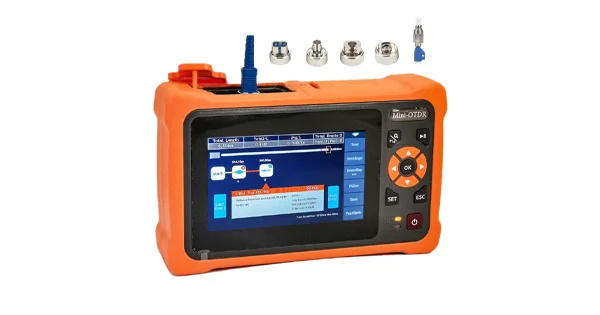
Because the NTU is the demarcation point, it is also a natural place for testing to begin. Providers test up to the NTU to confirm their service is delivered correctly, while customer-side issues are diagnosed from the NTU inward. For fiber connections, verifying the link up to the ONT/NTU uses the same optical test tools discussed throughout fiber work — power meters, light sources, and OTDRs.
Get the Right Fiber Tools and Test Equipment
Whether you are installing, terminating, or testing fiber up to the network termination point, the right tools make it reliable. Aevumix supplies a full range of optical communication products — termination tools, cleavers, strippers, cleaning and inspection tools, optical power meters, light sources, and OTDRs. If you would like help choosing tools for your fiber network, contact our team.
FAQs
What Is a Network Termination Unit?
An NTU is a device that acts as the demarcation point between the service provider’s network and the customer’s premises. It terminates the incoming line, converts the signal into usable interfaces such as Ethernet, and marks where the provider’s responsibility ends.
Is an NTU the Same as an ONT?
On a fiber connection, effectively yes — the ONT (Optical Network Terminal) performs the NTU function, terminating the optical line and handing off Ethernet to your router. On cable service, the cable modem performs the equivalent role.
What Does an NTU Do?
It terminates the provider’s line, converts the access signal into customer-usable interfaces, maintains signal integrity, marks the demarcation point, and often provides diagnostics and remote management for the provider.
Why Is the Demarcation Point Important?
It defines who is responsible for which part of the connection. Faults on the provider’s side of the NTU are theirs to fix; issues on your side are yours to troubleshoot. This boundary is often defined in regulation.
Where Is the NTU in My Home?
It is the box where the provider’s line enters and your router connects — on fiber, the ONT the technician installed. You plug your router into its Ethernet port to create your own network.